
What’s up: Sport meets show
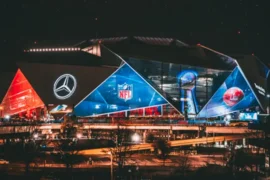
In this month’s What’s Up Student column, our EUSA ESC volunteer, Milia Molinie, takes us behind the scenes of the sports world to explore a lesser-known but powerful element of any major event — the staging.
On April 18, 2025, French boxer Bakary Samake delivered a stunning knockout in front of 38,500 spectators at Paris La Defense Arena, an event unlike any other. For the first time, a professional boxing match opened a major concert of French rapper Gazo, seamlessly blending sport and entertainment in a bold new format.
In the eighth round, Samake’s precise left hook sent his South African opponent to the canvas, counted out by the referee. The crowd erupted, not just for the music but for the unexpected thrill of the fight. “I knew there was boxing,” said Véni, 20, “It’s an incredible strategy from Gazo. I've seen this on TV but never live.”
This moment was more than a spectacle. It was a deliberate cultural crossover: boxing and rap, two pillars of French urban culture, joining forces to revive a sport struggling for mainstream attention. Despite 60,000 licensed boxers in France, professional boxing faces a plateau, pushing promoters to innovate with storytelling and spectacular staging that deliver both authentic competition and captivating entertainment.
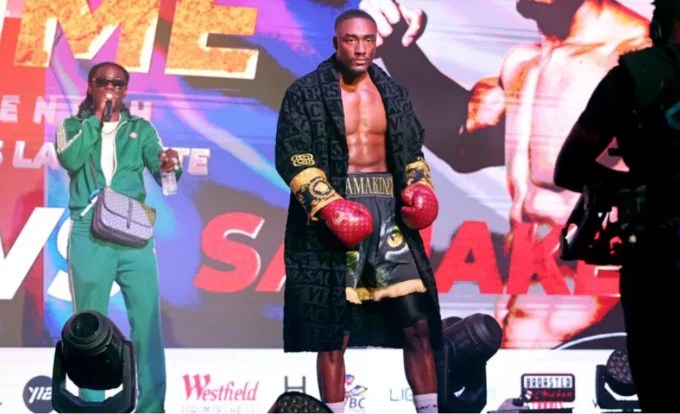
Credits:Denis Boulanger/Presse Sport
This phenomenon prompts a critical question: To what extent is the sports world undergoing a structural transformation toward “sportainment,” where the line between competition and show blurs?
Sport and the Entertainment Industry: Understanding a Deeply Intertwined Phenomenon
Why is the world of sport so intrinsically linked to entertainment culture? How does this connection still hold true today, and in what ways does entertainment culture shape the sports economy?
Emotion and Influence at the Heart of the Game
Sport has always told a story…
Since the revival of the modern Olympic Games in 1896, emotion has been at the heart of how sport is staged and experienced. Olympic opening ceremonies, far from being mere formalities, have become emotionally charged spectacles that blend national identity, cultural storytelling, and visual artistry. They condition the mood of the Games, shaping public perception and athlete performance alike.
Some ceremonies have left a lasting mark. The 1984 Los Angeles Olympics brought Hollywood showmanship into the world of sport, setting a new standard for entertainment-driven presentation. Beijing 2008 took this even further, delivering a highly choreographed display of precision and tradition designed to broadcast China’s emergence as a global power. In 2024, the Paris Olympics offered artistic tableaux like the “Equality Scene,” embedding powerful social messages within the sports narrative.
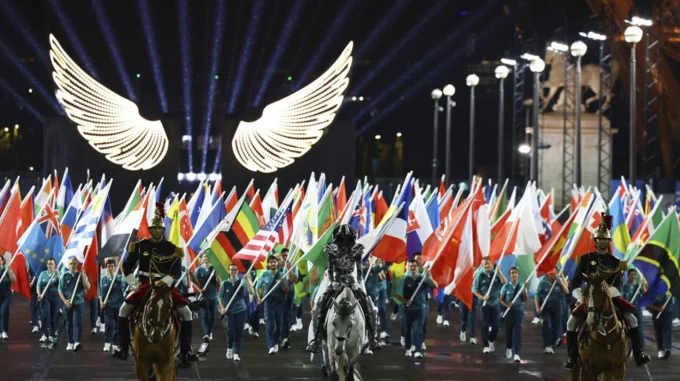
Credits: Stéphanie Lecocq
These examples show that large-scale sporting events are more than competitions: they are carefully crafted performances where culture and emotion play starring roles. And increasingly, the bridge between culture and sport serves as a tool of soft power. Nations use these global stages to project not only athletic strength but also values, ideologies, and identity. The artistic framing of sport becomes a diplomatic language, capable of shaping how countries are perceived on the world stage. In this sense, the emotional and symbolic power of sport is not just a tool for engagement but a strategic instrument of influence.
…Now it performs it
The emotional dimension extends beyond the Olympic stage and into rising combat sports like MMA, where the line between competition and spectacle becomes increasingly blurred. Much like the gladiatorial arenas of ancient Rome, modern MMA events are designed to thrill, provoke, and captivate. The sport has embraced showmanship as part of its core identity, entrances are choreographed, narratives are built around fighters, and the atmosphere is carefully engineered to amplify adrenaline and emotion.
On May 24, 2025, French rising star Paul Dena, just 23 years old, won his fight by knockout against Saber Talmoust. In his post-fight speech, Dena didn’t just thank his coaches or speak about strategy, he turned to the crowd and said: “Thank you all for coming. I hope you enjoyed the performance.” His words echoed those of a performer stepping offstage, not just a fighter stepping out of the ring. This moment perfectly encapsulates the evolution of the athlete into a kind of artist, someone expected not only to compete, but to deliver a show, to move and entertain. In today’s sporting landscape, emotion isn’t just a byproduct of the game, it’s the product being sold.
A global economic model?
The American culture of sports entertainment…
When we think about sports entertainment and large-attendance shows, we immediately think of the United States of America. The paradox of American sport lies in the coexistence of ultra-competitive professional leagues and a broader economic and social culture driven by consumerism. These two forces intertwine, turning the sporting experience into a full-fledged show, where high-performance athleticism meets entertainment, branding, and mass consumption. This “Americanization of sport” has transformed it into a multifaceted entertainment experience, where fan culture and immersive experiences take center stage. A prime example is the Super Bowl, which has evolved into a cultural and economic powerhouse. In 2025, Super Bowl LIX set a new record with 127.7 million viewers across all platforms, including television and streaming services like Tubi and NFL+. The peak audience reached 137.7 million during the second quarter of the game.

Credits: Doug Benc
This massive viewership translates into a substantial economic impact. The National Football League estimates that hosting the Super Bowl generates at least $500 million in economic benefits for the host city. Additionally, the average cost for a party of 10 people to attend or host a Super Bowl gathering is approximately $139. This integration of music, celebrity, and sport exemplifies the convergence of entertainment and athletic competition.
In contrast, European models of sport remain more traditional, focusing primarily on athletic performance. This disparity highlights the differing approaches to monetizing and presenting sport globally, with the American model emphasizing entertainment and fan engagement as central components of the sporting experience. However, the sports economy remains fragile, and the American model may offer some answers…
...driving the reinvention of fragile economic models
Despite ongoing efforts around projects labeled as the "Olympic Games legacy," the French National Olympic Committee (CNOSF) is facing a drastic budget cut of 75% compared to initial plans. This reduction will have significant consequences for local communities and the funding allocated to both amateur and professional clubs.
For example, the Orléans handball club’s men’s second division team, “The Septors”, did not wait to reinvent their economic model to increase revenue streams. The club’s management took a bold step by programming live showcases after matches, inviting some of France’s most popular artists, such as Ridsa, Bigflo & Oli, and M. Pokora. This strategy proved successful in attracting new audiences and gradually introducing them to the world of handball.

Many other clubs are adopting similar approaches, blending sport and entertainment, the two industries most under pressure when it comes to budget cuts. While still far from the American model, this pooling of resources and creativity appears to be a promising solution to sustain and grow sports in a financially challenging environment.
But can emotion reinvent itself indefinitely? Does the sports industry truly have an infinite capacity for renewal?
While sport thrives on passion and storytelling, these forces may face limits in a world increasingly saturated with spectacle and entertainment. The challenge lies in balancing authentic competition with ever-evolving showmanship, ensuring that emotion remains genuine and not just a manufactured product.
Breaking limits, building legends
Achievements often drive emotions, and, by extension, the sports industry itself. But do these performances have an expiration date? Are athletes still simply competitors, or have they taken on roles that go far beyond sport…?
Record-Breaking or Story-Making?
Faster, Higher, Stronger: Until When?
Breaking records has long been the driving force behind the spectacle of sport. The familiar phrase "records are made to be broken" captures the excitement of witnessing human limits pushed further. But how much longer can we expect to see records shattered? Geoffroy Berthelot, a researcher at INSEP (the National Institute of Sport, Expertise, and Performance in France), analyzed the history of Olympic records dating back to 1896. In 2012, he concluded that athletes have reached 99% of their physical potential. According to the mathematical model he developed, by 2027, when half of the 147 disciplines he studied will have reached “saturation,” records will improve by no more than 0.05%.
This plateau is also tied to revolutionary changes within the sports industry. As Éric Berton, director of the Institute of Movement Sciences, explains, record-breaking now hinges on micro-details. Before the 2000s, athletes trained mostly on their own with a single coach applying known methods. Today, coaches willingly collaborate with a team of specialists: mental trainers, nutritionists, and scientists, to fine-tune every aspect of performance. This shift highlights how, in an era where physical limits approach their peak, innovation has become the new frontier in sports.
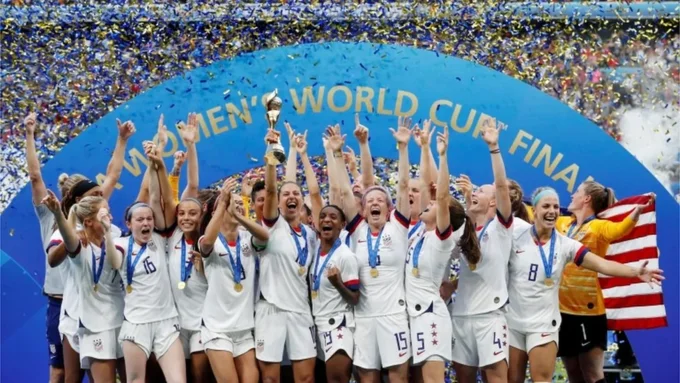
But records are not limited to athletic performance alone, they also extend to audience figures. For example, the 2019 FIFA Women’s World Cup set a record with over 1 billion viewers worldwide on television. This milestone is partly the result of deliberate efforts to enhance the event’s entertainment value, including concerts, shows, and other spectacle-driven programming. This is an encouraging sign for the future of women’s sports, which often face demands for immediate results while contending with a 50-year lag behind men’s football in terms of investment and development. Indeed, female players in France’s top division only gained professional status in July 2024. Thus, breaking audience records and integrating entertainment into sports events can have a positive impact on the growth and recognition of emerging disciplines.
No story, no glory: why do athletes need a narrative?
Today, beyond breaking records, athletes need to shine and become stars. Not only to carve out their place and leave their mark on their sport, but also to attract sponsors. Everyone remembers Usain Bolt’s iconic celebration. Although he still holds the world records in the 100m and 200m, Bolt retired in 2017 and in 2022 took the unprecedented step of filing a patent for his famous celebration with the U.S. Patent Office. His appeal had already transcended sport, but now he is a true legend seeking to capitalize fully on his popularity.
More recently, young athletes entering disciplines already defined by legendary figures must reinvent themselves and set new kinds of records, beyond the conventional ones already dominated by history. This is particularly true in basketball and the NBA, where legends like Kobe Bryant, LeBron James, Stephen Curry, and Kevin Durant have left an indelible mark. Surpassing these veterans is a tall order.
For instance, Victor Wembanyama, the number one pick in the 2023 NBA Draft, has repeatedly expressed his desire to leave a unique imprint on the game. Many records are already set in stone, so creativity becomes essential both on and off the court. His nickname, “The Alien,” exemplifies the storytelling crafted around him by the 7-foot-4-inch phenom. By positioning himself as “one of a kind,” Wembanyama is creating new categories of records. This sometimes even draws playful criticism from Stephen Curry, who thanked NBA statisticians for inventing new record categories “just so I can break another one.”
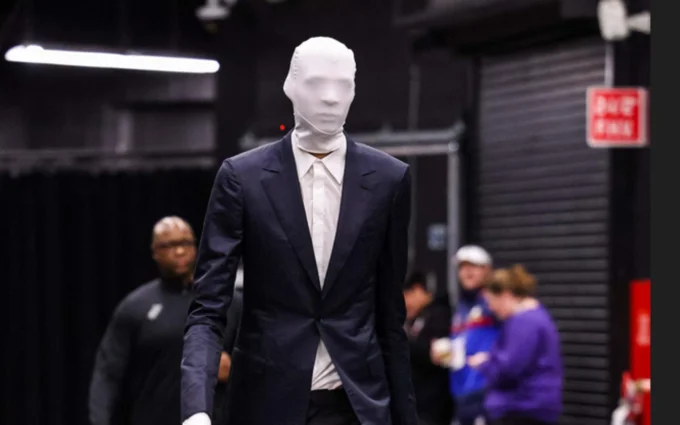
Credits: Mike Christy
In short, records are made to be broken, but once athletes approach the limits of human performance, how do they continue to innovate? Creativity appears to be the key, enabling continuous novelty in gameplay, entertainment, and renewal. This storytelling strategy not only attracts sponsors and enhances brand image for players and franchises alike but also signals a new approach to performance, one increasingly tied to individual creativity.
From team player to star power
How the spectacle is reshaping team sports around individual performances
The breaking of records and the reinvention of what captivates audiences and drives the sports industry seem to have profound effects on the individualization of athletes themselves. Even within team sports, it is increasingly important to spotlight individual stars. Victory alone no longer guarantees success; instead, the spectacle and style of play take center stage. For example, French footballer Kylian Mbappé often faces criticism when his performance falls short of his peak form because he has accustomed fans to a show-worthy level of play. In fact, a uniquely French phenomenon known as “the Mbappé project” has emerged, where parents of young boys, sometimes as young as eight, take on the role of their child’s agent to mold them into future football stars. This star-making culture is problematic as it elevates young athletes into individual figures chasing success, often at the expense of the collective values of team sports.
This trend is amplified by the way sports are commented on: in Spain, a spectacular goal is called a “golazo,” while in basketball, what counts are statistics like “double-doubles” or “triple-doubles.” Moreover, the NBA embraces innovative formats that focus on individual skills rather than team play, especially during the All-Star Weekend with events like the Skills Challenge and Dunk Contest. These showcases place entertainment at the forefront and can significantly impact players’ careers. For instance, this year, San Antonio Spurs rookie Stephon Castle earned the Rookie of the Year title after a standout performance in the Dunk Contest.
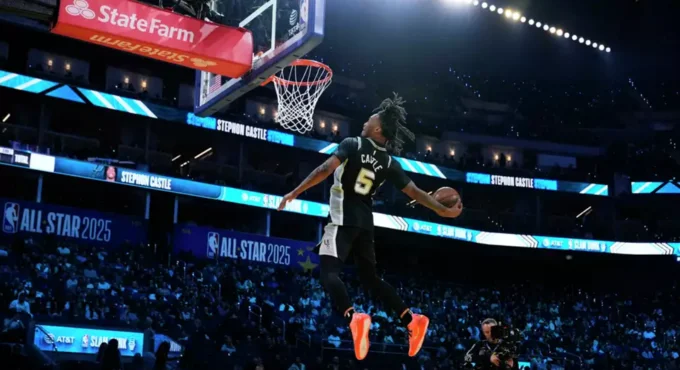
Credits: Godofredo A. Vásquez - Associated Press
Can the spotlight lead to structural changes?
All these phenomena illustrate how sport is evolving today. But is there only a negative side? The impact of sport as spectacle needs to be nuanced, as it can also serve as a window for promising social progress, notably in advancing gender equality in sports. Take, for example, the previously mentioned 2019 FIFA Women’s World Cup. Following this high-profile event, Megan Rapinoe emerged as a leading figure in the fight for equal pay between male and female athletes. The record-breaking viewership marked a crucial milestone for gender equality in sport.
Similarly, on the basketball front and within the WNBA, we are witnessing a genuine shift in popularity. Was the women’s league lacking major stars for its franchises? Caitlin Clark, point guard for the Indiana Fever, appears to have followed in the footsteps of Sabrina Ionescu, opening the door to a sudden surge in attention for women’s basketball. Her highlight reels are watched worldwide, sparking viral moments and capturing the public’s imagination.
In fact, the French overall number two pick in the 2025 WNBA Draft, Dominique Malonga, stands out not only for her height, 1.98 meters, but also for her above-average dunking skills. These spectacular dunks ignite fan excitement and draw the spotlight to her. Just a few years ago, dunking was rare even among male players, and now, individual female athletes are proving through such spectacular feats that they, too, are capable of thrilling performances.
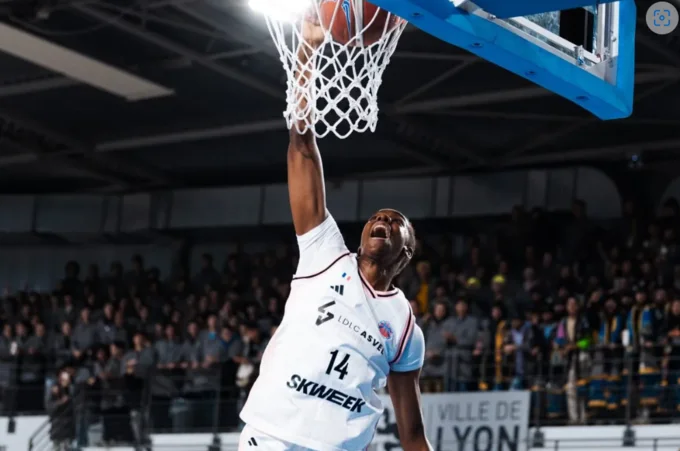
Credits: Infinity Nine Media
While this remains speculative for now, these highlight-worthy moments could significantly impact media coverage and shift public perceptions about women’s sports. It is important to remember that the WNBA benefits from substantial resources, a reality not always shared by European leagues or those in developing countries. However, since the United States often sets trends for the global sports industry, these phenomena could leave a lasting mark internationally.
In conclusion, sport as spectacle has always existed, whether literally blending sport with entertainment and showmanship, or more recently through star-making, memorable performances, and the constant desire to leave a lasting impression. We have touched on the starification of athletes, but are we moving toward their dehumanization? Can we still simply call them athletes when performance sometimes overshadows fair play (doping, cheating)? Moreover, is technology truly an ally to the athlete, or does it serve a system that always demands more? One thing is certain: today, athletes are no longer just competitors; they are increasingly at the center of the spotlight, sometimes unwillingly, but often driving large-scale, promising changes.
The author of the text is Milia Molinie from France, a graduate with a Master's degree in international cooperation and development from both the University of Bordeaux, France, and Turin, Italy, who is currently serving as a European Solidarity Corps volunteer at the EUSA Office in Ljubljana.
Are you a student with an opinion? We are looking for new contributors for our student column every month. Feel free to contact stc@eusa.eu to offer a piece or propose a topic.