
EUSA-FISU Strategic Dialogue 2025
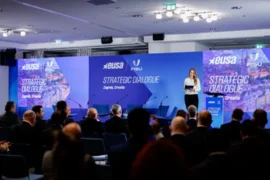
In the afternoon of October 9, 2025, members of the worldwide university sports community came together for the Strategic Dialogue to review past achievements, evaluate the current landscape, and shape a vision for the future of student sports in Europe and beyond.
The EUSA-FISU Strategic Dialogue is designed to bring together, inspire, and empower university sport stakeholders across Europe, helping them better understand their needs and realities, and fostering effective collaboration for the advancement of university sport.
Organised jointly by the European University Sports Association (EUSA) and the International University Sports Federation (FISU), the event took place in conjunction with the EUSA General Assembly, Awards Ceremony and Gala, hosted in Zagreb by the Croatian Academic Sports Federation (CASF).

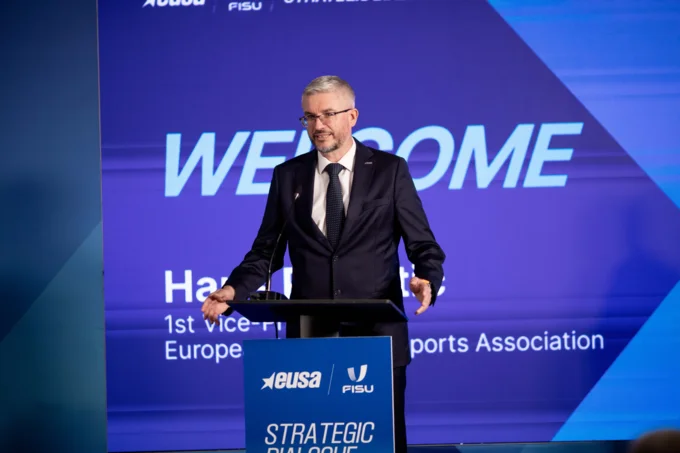
The Strategic Dialogue opened with a warm welcome on stage from Haris Pavletic, President of the Croatian Academic Sports Federation (CASF), Adam Roczek, President of the European University Sports Association (EUSA), and Leonz Eder, President of the International University Sports Federation (FISU).
Haris Pavletic greeted the large audience gathered in Zagreb, expressing delight at the impressive turnout and emphasising that participants should feel at home during the upcoming three days of exchange and discussion. They wished everyone productive and enjoyable days ahead.
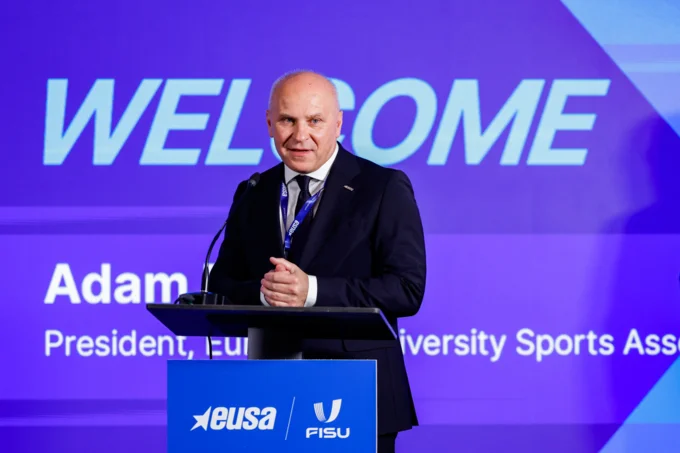
Adam Roczek thanked the hosts for organising the event, as well FISU for the ongoing collaboration and support. He expressed happiness to see so many participants and voiced hope that the panels and discussions would be engaging and inspiring for all.
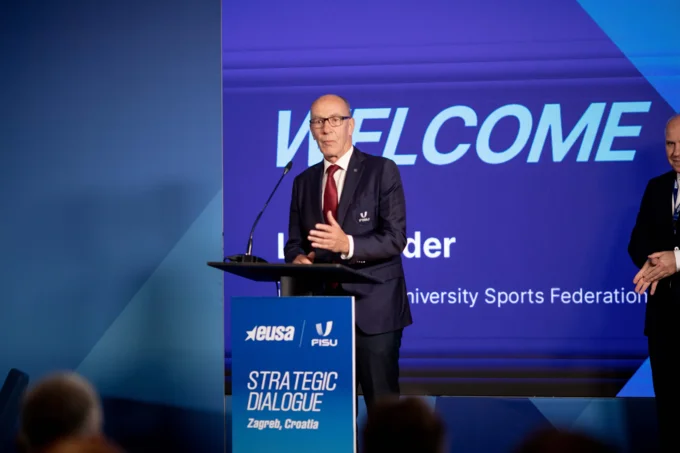
Leonz Eder highlighted the honour and pleasure of welcoming friends from across the continent, underlining that the Strategic Dialogue is not only a platform for exchanging ideas but also for learning from one another and shaping a brighter future together.
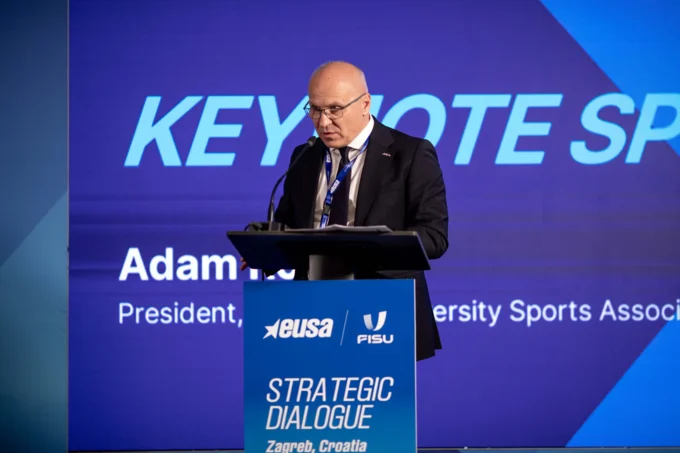
The opening keynote was delivered by EUSA President Adam Roczek, reflecting on Europe’s unique diversity and its long-standing relationship with sport. Drawing on the historical roots of sport in ancient Greece and the Olympic Games, he spoke about sport as a bridge for peace and unity. He also highlighted the foundational role of university sport in shaping international sporting values, closing his address with a powerful reminder inspired by Nelson Mandela’s words: “Sport has the power to change and inspire.”
The first panel "University sport in Europe: past, present and future" focused on the evolution of university sport across the European continent, emphasising key achievements, current challenges, and future opportunities. The discussion brought together prominent voices in the field, including Leonz Eder, FISU President; Haris Pavletic, EUSA 1st Vice-President; Milan Zvan, Chair of EUSA’s Education Commission; and Amalie Husby, President of the Norwegian Association of University Sports.
Moderated by Sara Rozman, Director of Education & Operations at EUSA, the panel stressed the need to adapt to changing student lifestyles, digital engagement, and inclusivity within sports programmes.
During the panel discussion, various questions prompted diverse perspectives. When asked, “FISU has a global perspective on university sport. From your viewpoint, what has been Europe’s greatest contribution to the international university sport movement?” Leonz Eder responded that EUSA has evolved into an exemplary continental association. He highlighted that it is highly structured and well-organised, offers a diverse program, and maintains close relationships with sports associations, political institutions, and academic bodies. Eder emphasised that EUSA serves as a model for others, noting that its strength is reflected in the ease with which host cities for the EUSA Games are found, something that is far from challenging.

Haris Pavletic reflected on the strategic role EUSA can play in influencing how the European Union approaches university sport. He emphasised the need for projects that engage a large number of students in regular physical activity, not just those who compete at high levels, and that promote exercise and healthy lifestyles among all students, including non-professional athletes. Strategic thinking and innovative programs are essential to reach these broader student populations and maximise the impact of university sport across Europe.

Amelie Husby added to the conversation by emphasising the strong influence of NUSAs and the differences between national approaches to university sport. She shared insights from the Norwegian model, stressing the importance of a “by and for the students” approach, encouraging cooperation between experienced and younger participants. She concluded that exchanges across ages and borders represent the most meaningful way to share knowledge and strengthen the university sports community.

On the topic of what defines a truly “sport-friendly university” in today’s Europe? - Milan Zvan explained that such universities are capable of helping students balance academics and sport, ensuring that athletes do not have to sacrifice their studies to compete at a high level. Sport-friendly universities provide access to top training facilities, medical and fitness support, and psychological assistance, allowing students to combine academic success with athletic development. Creating this supportive environment is crucial to fostering both performance and well-being.

The panel also touched upon the broader social role of sport. Participants agreed that sport fosters social bonds, provides opportunities for healthier lifestyles, and helps bridge gaps between different groups of people who practice sport in varying ways. In an era dominated by digitalisation, speakers raised the question of what educational benefits can be achieved by bringing people together through sport, as a way to counteract isolation and promote real-life connection, teamwork, and well-being.
After a networking coffee break, the second session was introduced by Adam Roczek, who highlighted the critical role of global collaboration.
The second panel of the day "FISU and the continental federations: connecting ideas, creating impact" united voices from across different continents to share ideas and promote international cooperation. Participants included Matthias Remund, Secretary General & CEO of FISU; Matjaz Pecovnik, Secretary General & CEO of EUSA; Peninnah Kabenge Aligawesa, Secretary General of the Federation of Africa University Sports; and Luciano Atayde Costa Cabral, Representative of FISU America.
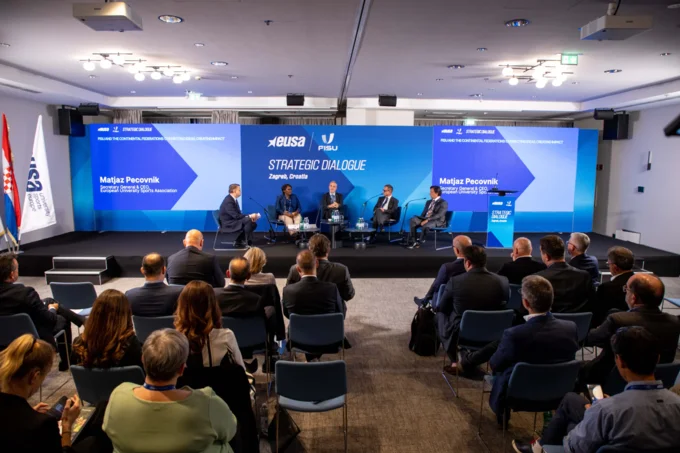
Moderated by Stefan Berg, Chair of FISU’s Development Committee, the discussion underscored the importance of intercontinental partnerships, knowledge sharing, and building sustainable structures that benefit student-athletes worldwide.
When discussing collaboration and partnerships, Matjaz Pecovnik highlighted EUSA’s development and solidarity programs, noting that the association’s strength comes from the support of its diverse member federations. He emphasized the importance of assisting federations that encounter challenges in participating in university sports events, engaging with them directly to identify the most effective ways to help. Ultimately, he stressed that support is fundamentally about people, focusing on both the delegates involved and the wider university sport community.

Speaking about challenges, Luciano Cabral elaborated on how challenges in continental federations are often similar across different regions, though they may manifest differently due to cultural contexts. In parts of the Americas, for example, authorities often prioritize elite or higher-education sports over university sport. He emphasized the need to demonstrate the importance of supporting and promoting sports for young people, organizing “sport for all” initiatives, and most importantly, creating opportunities like this to collaborate and develop shared strategies for growth.

On the topic of the student role in developing university sports, Peninnah Kabenge highlighted the pivotal role of students in Africa, where they actively support and participate in the federation. She noted that a student representative is part of the executive committee and that the office is run by both volunteers and students, who engage wholeheartedly, take initiative, and drive progress.

To connect it all, Matthias Remud reflected on his colleagues’ comments, emphasising the need to support all continents by defining common goals for how FISU can assist continental federations. He highlighted the importance of setting clear directions while providing tailored support to individual federations in the most efficient way possible.

Part of the discussion focused on inclusion and exploring ways to better integrate para sports in the future, ensuring broader participation and equal opportunities for all athletes, as well as what a truly globally connected university sport community looks like.
The programme concluded with closing remarks, wrapping up a day rich in dialogue and strategic insights.
This year’s Strategic Dialogue reaffirmed the commitment of university sport leaders to strengthen collaboration, enhance the student experience, and ensure that university sport continues to be a driver of education, inclusion, and international understanding.